
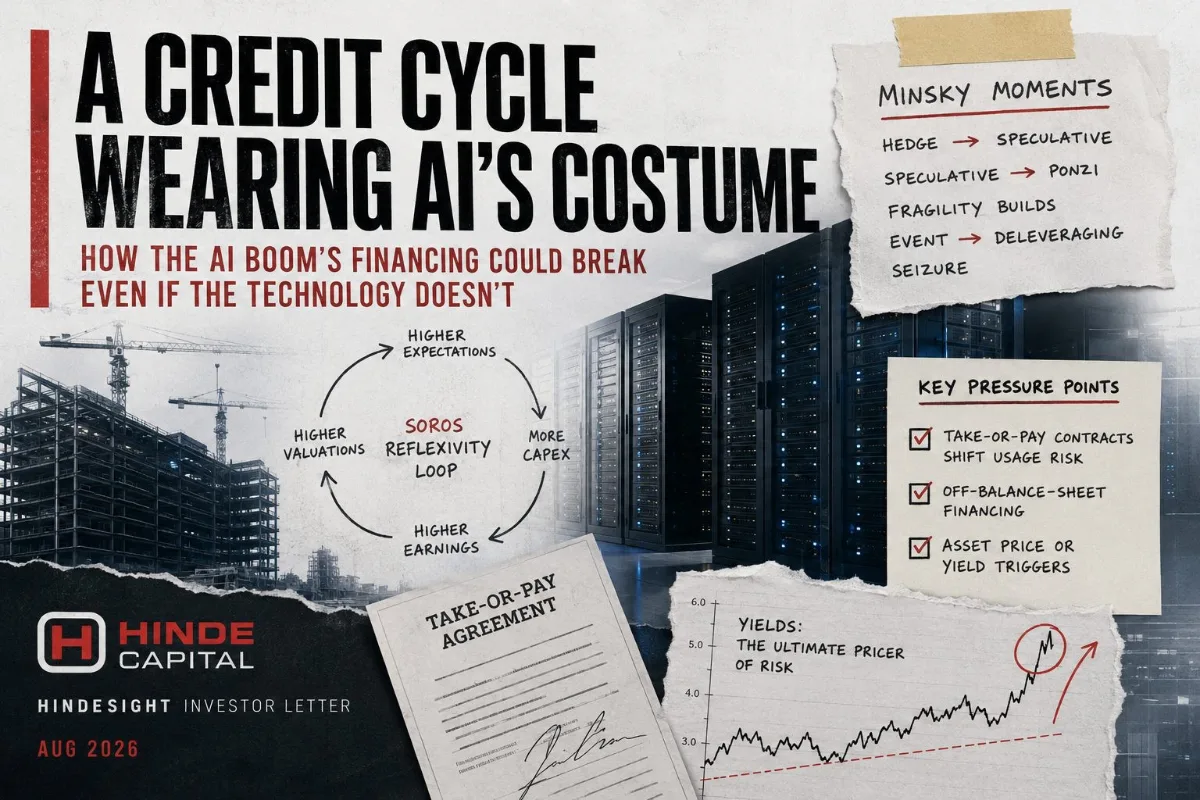
A technology can succeed completely, and the people who financed its build-out can still lose everything.
I saw this dynamic up close once before. Early in my career I worked for a hedge fund in Australia trading Japanese equities, under a genuinely gifted manager of capital who was short Advantest during the telecom fibre bubble. He had worked out that the fibre optic capacity being priced into those businesses implied enough cable to wrap around the earth at the equator many thousands of times over, a level of forward capacity so far beyond any plausible demand curve that the valuations only made sense if nobody bothered to ask the physical question at all. The capex was financed on pricing power assumptions that competition subsequently destroyed.
The internet succeeded completely. Fibre capacity was genuinely, permanently valuable. And most of the companies that built it went bankrupt anyway. Technology can succeed, category winners can emerge, and the entities currently building the infrastructure can still fail to capture the value they created. That is not a story about whether a technology works. It is a story about financing structure, about how much of a buildout is funded by debt or off-balance-sheet vehicles versus free cash flow, and about who absorbs the loss if utilisation disappoints. It is a traditional credit-cycle question wearing a new technology's costume, and it can bite regardless of whether that technology ultimately succeeds.
Regular readers of these HindeSight letters from the 2000s and 2010s era will recognise the theme underneath what follows. I thought it easier to write these market missives under the old HindeSight format again, even though Hinde Capital no longer runs external capital. We have written before about Austrian business-cycle theory, about how credit expansion misprices the cost of capital and directs investment toward projects that only make sense at that mispriced cost, and about the financialisation of everything, the way speculative behaviour has spread from Wall Street balance sheets into the ordinary financing of Main Street life. We are, I think, running something close to a speculative economy today, and AI is now the clearest expression of it.
These thoughts draw on two further frameworks to make the point more precise. George Soros's theory of reflexivity explains how investor perception and market prices can shape each other, so that a rising valuation can help create the very earnings that appear to justify it. Hyman Minsky's Financial Instability Hypothesis explains what tends to happen next, how a period of stability quietly migrates financing from arrangements that are self-funding toward ones that depend on refinancing and rising prices to survive. Together they describe something more specific than a bubble. They describe how a technology can work exactly as promised while the financial structure built around it breaks anyway.
What follows unfolds in stages rather than as a single case. It starts with the reflexive loop connecting AI valuations, capital expenditure and reported earnings. It then follows the financing underneath that loop, through Nvidia's own balance sheet, the take-or-pay contracts that now dominate compute deals, and the bond market that ultimately prices all of it. Two further threads run alongside the main one and do not depend on it, the asymmetric effect of automation on consumption, and the unresolved question of who actually captures the value AI creates as its own cost collapses. The piece closes by pulling all of it into one place.
I keep coming back to what I think is one of the most interesting distinctions between today's AI boom and the TMT bubble of 2000. Back then, equity valuations ran far ahead of the earnings required to justify them. The technological promise of the internet was ultimately correct, but in many cases the revenues and profits simply did not arrive quickly enough to support the extraordinary prices investors had already paid.
This time is different, at least so far. The earnings have arrived.
AI infrastructure spending has produced extraordinary revenues and profits across the companies supplying the boom, most obviously Nvidia. This creates a legitimate argument that today's valuations are fundamentally supported in a way that many technology valuations simply were not in 2000. Even after enormous increases in share prices, equally extraordinary increases in earnings can prevent P/E multiples from looking obviously absurd. That makes the current debate considerably more complicated than simply arguing that AI stocks have become too expensive.
My question is whether both sides of the P/E equation may now be reflexive. Prices may have risen too far and too quickly, but what if the earnings being used to justify those prices have themselves risen too far and too quickly because they are being amplified by an unprecedented AI capital-expenditure and financing cycle?
That raises the possibility of something rather different from the 2000 technology bubble. We may not simply have an asset-price bubble built upon distant expectations of future earnings. We may have the beginnings of an earnings bubble sitting underneath an asset-price boom, where extraordinary capital expenditure creates extraordinary supplier revenues and profits, those profits make record equity prices appear fundamentally justified, and those apparently justified valuations attract the capital required to finance the next round of expenditure.
That does not mean the earnings are fictitious. They are very real. Nor does it mean AI will fail technologically. Quite the opposite. AI can transform the economy, compute demand can increase by orders of magnitude and productivity can explode. The question is whether the current rate of investment, earnings growth and capital appreciation has moved too far, too quickly, and whether each is now helping reinforce the others.
That is a much more difficult bubble to identify because, unlike 2000, the fundamentals themselves appear to confirm the price. And that is precisely why Soros's reflexivity and Minsky's Financial Instability Hypothesis become so useful in thinking about what happens next.
Put simply, both sides of the P/E equation may now be reflexive. The numerator may be inflated by reflexive valuation, while the denominator may be inflated by reflexive capital expenditure. If the cycle turns, the process can operate just as powerfully in reverse, leaving investors facing earnings contraction and multiple contraction simultaneously.
From a Simple Diagram to Soros and Minsky
The genesis of this piece was actually much simpler than the rather large rabbit hole it subsequently became.
A long-term friend of mine, Stuart Hill, formerly a proprietary trader at CSFB and Greenwich Capital, sent me a thoughtful flow diagram, beautiful in its simplicity, setting out how he was thinking about the extraordinary reflexivity developing around AI and the US equity market.
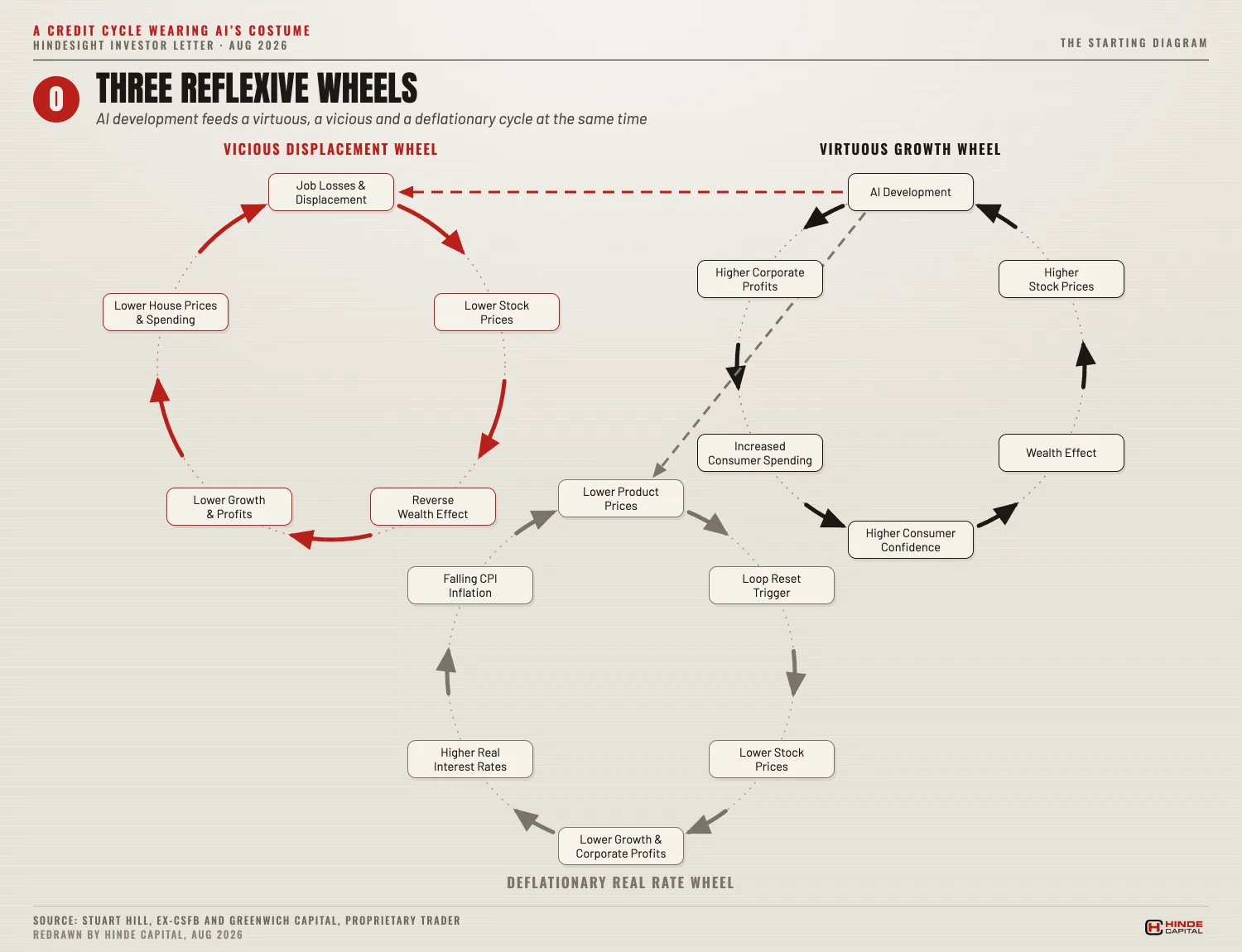
Stuart's starting point was very Soros-like. AI is not simply producing an economic boom to which financial markets are responding. The financial-market response is itself helping to produce the economic boom. Rising expectations about AI productivity increase corporate investment, expected profits and equity valuations. Rising equity valuations increase household wealth and confidence, support consumption and reduce the effective cost of capital for corporations. That encourages still more AI investment, which generates additional revenues and profits and appears to validate the valuations which started the process.
I replied to Stuart on WhatsApp, discussing this classic Soros reflexive process, in this case that AI expectations drive investment, profits and equity valuations; higher equity valuations increase wealth, confidence and spending, reinforcing profits and seemingly validating the original valuations. For now, the positive asset-price and capital-expenditure effects appear to be overwhelming the negative employment effects from automation and displacement.
But what happens if that changes?
If the negative employment impulse reaches sufficient scale, or investors independently begin questioning AI returns, equities can fall. The wealth effect then reverses, consumption weakens, profits decline and equities fall further. At precisely the moment the positive reflexive loop begins running backwards, the employment-displacement loop may be strengthening.
If AI-driven productivity also pushes inflation down faster than nominal interest rates decline, rising real rates potentially create a third deflationary feedback loop. The three mechanisms can then reinforce one another until monetary or fiscal authorities intervene aggressively.
The key insight was this. The risk isn't necessarily that AI fails. AI could succeed technologically and still destabilise the economic and financial system. Indeed, under the logic of Stuart's diagram, very rapid AI success could potentially prove more destabilising if labour displacement and deflation arrive faster than households, fiscal policy, monetary policy and the political system can adjust.
Popper's Muse
To understand why, it is worth being precise about Soros's concept of reflexivity, because it is considerably more interesting than simply saying markets sometimes become bubbles.
Soros's idea has its origins not principally in economics but in the philosophy of knowledge, influenced by his time studying under Karl Popper. At its heart is an epistemological problem. Market participants are trying to understand a reality of which they are themselves participants. Their perceptions are inevitably imperfect, but their decisions based upon those perceptions can change the reality they are attempting to understand.
There are therefore two directions to the relationship. Economic fundamentals influence investors' perceptions and market prices, but market prices can simultaneously influence economic fundamentals. Cause and effect begin operating in both directions.
A rising share price, for example, is not necessarily just the passive consequence of improving fundamentals. The higher share price itself can improve those fundamentals. It lowers the company's cost of equity capital, allows acquisitions to be financed with expensive stock, improves employee compensation through options, increases management confidence and can strengthen lenders' perceptions of creditworthiness. It also encourages additional investment. That investment becomes somebody else's revenue and potentially produces the earnings growth investors originally anticipated.
Perception influences price, price changes behaviour, behaviour changes fundamentals, and those changed fundamentals reinforce the original perception.
That is Soros reflexivity.
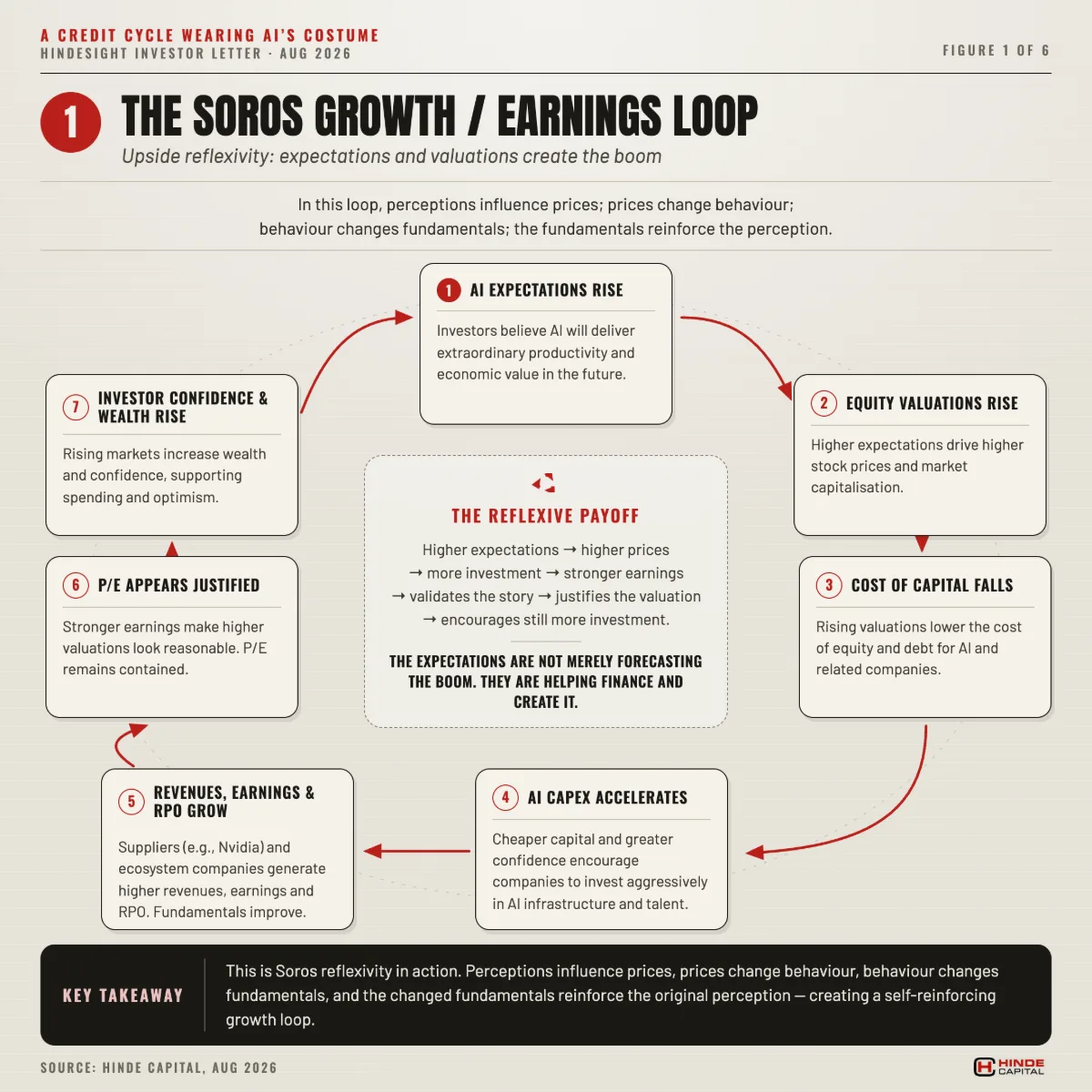
The really important implication is that markets do not necessarily move continuously towards some independently existing equilibrium value. For extended periods, market prices can move fundamentals themselves. An initially exaggerated belief can therefore partially manufacture the economic evidence which appears to prove that the belief was correct.
This is exactly why AI is such fertile territory for reflexivity.
Investors believe AI will generate extraordinary productivity gains. AI-related equity valuations rise. Those valuations lower the cost of capital and encourage enormous investment. The investment becomes revenue for Nvidia, data-centre developers, utilities, semiconductor manufacturers and the wider infrastructure complex. Those revenues become reported earnings. The earnings validate the AI narrative. Equity prices rise again, capital becomes still more available and another round of investment begins.
The expectations are not merely forecasting the boom. They are helping finance and create it.
Minsky Muses – Stability Breeds Instability
This is where Hyman Minsky becomes so interesting.
Minsky's Financial Instability Hypothesis, or FIH, is related in spirit to Soros's reflexivity, but it is not the same theory. They come from very different intellectual traditions. Soros's reflexivity has philosophical roots in questions of knowledge, perception and fallibility. Minsky came from Post-Keynesian economics, building particularly upon Keynes's thinking about uncertainty, investment and financial behaviour.
Soros gives us a broad framework for understanding how perceptions and reality interact reflexively. Minsky gives us something much more specific, a theory about what prolonged success does to balance sheets and financing structures.
His deceptively simple insight was that stability itself can become destabilising; ‘stability breeds instability.’
When an economy experiences a long period of stable growth, rising asset prices and low defaults, lenders and borrowers quite rationally become more comfortable taking risk. The memory of the previous crisis fades. Credit spreads compress. Collateral values rise. Lenders increase advance rates. Borrowers accept more leverage because the previous leverage worked.
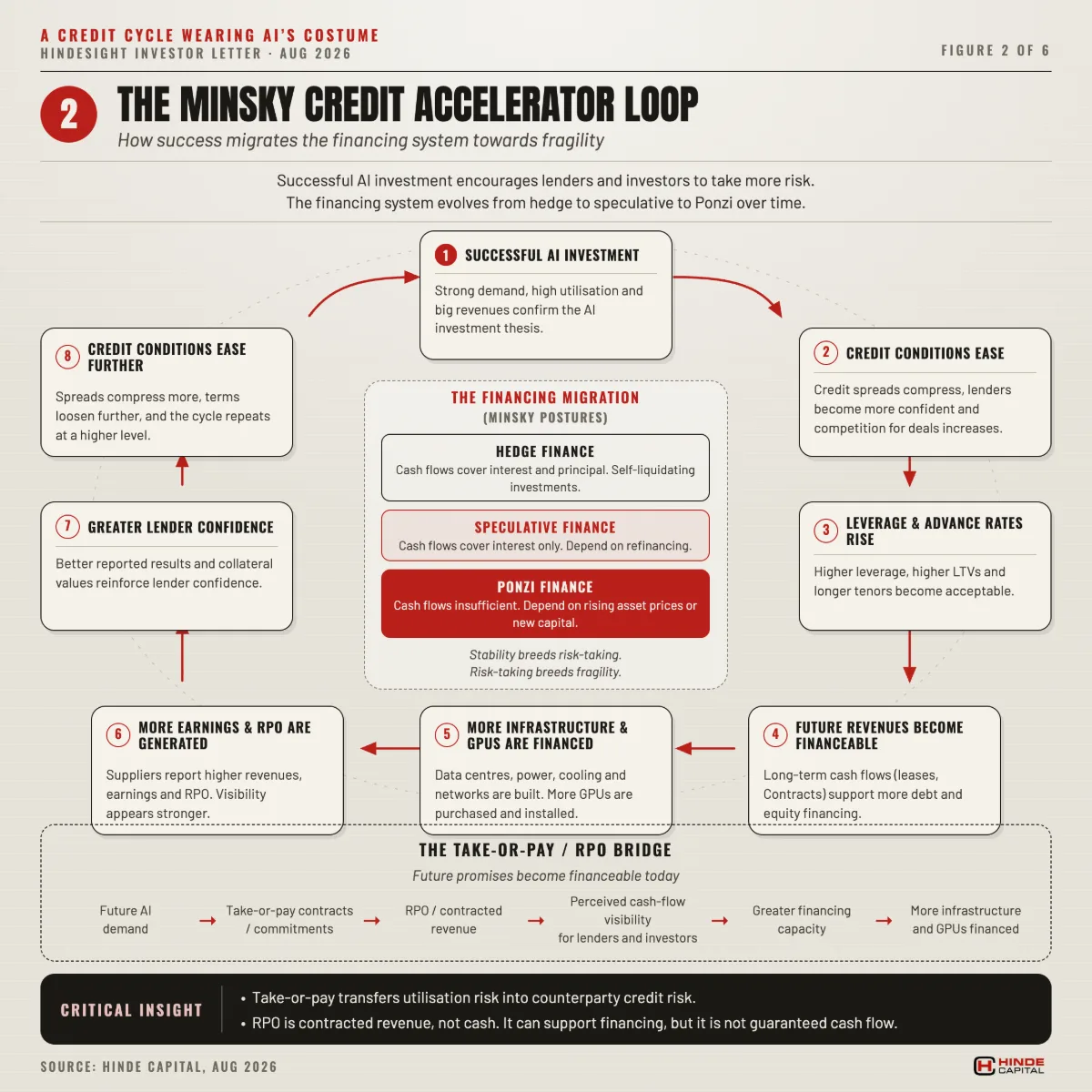
Minsky mapped this evolution through three financing postures. In hedge finance, underlying cash flows cover both interest and principal. The investment is economically self-liquidating and does not depend upon favourable capital markets to survive. In speculative finance, cash flows cover interest but not the repayment of principal, meaning the borrower depends upon refinancing. Finally, in Ponzi finance, underlying cash flows cannot support the complete financing burden and the structure increasingly depends upon rising asset values, additional capital or somebody else refinancing it.
The critical point is that the system does not ordinarily leap directly from prudent financing into Ponzi financing. It migrates there because the previous financing was successful.
That is what makes the migration so hard to see while it is happening. Nobody wakes up one morning and decides to underwrite Ponzi finance. Each step away from hedge finance is a small, locally rational response to the step before it working, a lender extending slightly better terms because the last loan performed, a borrower accepting slightly more leverage because the last round paid off. No single decision in the chain looks reckless from where the person making it is standing. The system arrives at fragility through a long sequence of individually sensible choices, which is precisely what makes it insidious rather than obviously foolish.
Stability encourages behaviours which gradually make the system less stable. Eventually something relatively mundane, such as higher interest rates, weaker cash flows, tighter credit or simply an asset price which stops appreciating, can expose the financing structures accumulated during the boom. Forced deleveraging pushes asset prices lower, which damages collateral elsewhere, which causes lenders to tighten further. That is the dynamic popularly associated with a Minsky moment.
The similarities with Soros are obvious, but the distinction matters. Soros is broader. Reflexivity can describe a technology equity bubble, currency crisis or even a non-financial social phenomenon without requiring leverage. Minsky is specifically concerned with cash flows, debt, collateral, leverage and refinancing.
The way I think about their relationship is that Minsky's Financial Instability Hypothesis can sit inside Soros's broader reflexivity framework. Soros explains how perception can begin changing the fundamentals. Minsky explains how the financial system can leverage that changed reality.
Together they provide a particularly powerful framework for understanding what may now be happening around AI.
The Size of the Prize
The obvious challenge to this argument is that the scale of the potential AI opportunity is so enormous that today's investment and earnings may ultimately prove entirely rational. Perhaps we are not overbuilding at all. Perhaps we are still dramatically underestimating the amount of compute the world will eventually consume.
This is where the views of Dario Amodei and Elon Musk become particularly useful, because both are profoundly bullish about the ultimate scale of AI, but each identifies a different constraint on getting from today's capital expenditure to tomorrow's economic returns.
Dario Amodei, Anthropic's CEO and co-founder, gives us one way of thinking about the size of the prize. Global labour represents something like $60 trillion of annual economic value. If AI ultimately captures only a relatively small percentage of that work, you can begin constructing numbers such as $3 trillion of annual AI industry revenues and potentially tens of trillions of dollars of corporate equity value. Anthropic is reportedly now talking about an addressable market exceeding $30 trillion annually. Numbers of this magnitude can make today's extraordinary capital expenditure appear almost trivial relative to the potential opportunity.
But importantly, Amodei himself identifies precisely the timing problem which sits at the heart of my argument. If an AI company builds infrastructure assuming revenues increase tenfold and growth ultimately comes in at fivefold, or simply arrives a year later than expected, the company can get into serious financial trouble despite being directionally correct about the technology.
The issue is therefore not simply whether demand eventually exists. It is whether the cash flows arrive quickly enough to justify the capital expenditure already committed to producing them, and whether the financing structure can survive the gap between the two.
Being right about terminal demand does not make timing irrelevant when the journey is financed with debt, leases, depreciating technology and enormous fixed commitments.
Elon Musk approaches essentially the same problem from the opposite direction. He thinks the market may still be underestimating the eventual demand for compute from AI agents, autonomy, robotics and inference. His concern increasingly appears to be physical rather than financial. Where does all the electricity come from?
Where are the turbines, transformers, grid connections, cooling systems and ultimately the generating capacity required to energise this enormous amount of compute?
Power is not the only constraint of this kind. Advanced packaging capacity, the CoWoS process Nvidia depends on to assemble its highest-end GPUs, and high-bandwidth memory, known as HBM, a stacked form of DRAM built for the data throughput a GPU needs and supplied almost entirely by SK Hynix, Samsung and Micron, are both running close to full utilisation. Some analysts see that bottleneck binding before the power one does.
The uncertainty extends well beyond software and hardware supply. Governments increasingly view frontier AI as strategically important infrastructure. Compute capacity, semiconductor supply chains and foundation models are becoming matters of national security as much as commercial competition. Whether this ultimately results in subsidies, regulation, mandated domestic capacity or even partial state ownership remains unclear. Nevertheless, geopolitical considerations now form part of the valuation framework in a way they rarely have for previous technology cycles.
There is a further wrinkle worth holding alongside the power and packaging constraints. Robotics and humanoid platforms, increasingly trained and coordinated by the same frontier models, extend AI's substitution pressure into manual and physical labour as well as knowledge work. Precisely because humanoid robotics is compute-intensive, requiring real-time perception, planning and control rather than simple pre-programmed motion, that extension does not necessarily mean less demand for chips and infrastructure. It could mean substantially more. A world where AI displaces physical as well as cognitive labour is plausibly a world of even greater compute demand, since embodied intelligence at scale requires inference running continuously across millions of physical units rather than intermittently through a browser tab. The more thoroughly AI succeeds at replacing labour, the more the economic assumptions underpinning today's valuations come under pressure, yet the same success is also what would most durably justify today's infrastructure spending on its own terms.
This creates an interesting tension. Amodei worries about building the compute too far ahead of the revenues. Musk worries about the physical infrastructure arriving too slowly to support the compute demand. Both can be right simultaneously. And if they are, the timing mismatch between technological demand, physical infrastructure and financial commitments becomes enormously important.
Imagine purchasing billions of dollars of GPUs because the eventual demand for computation is unquestionably enormous, only to discover that the data centre cannot be energised for another eighteen months because the power infrastructure has not arrived. The GPUs may physically sit there perfectly safely, but their economic depreciation clock is running. Another Nvidia architecture arrives, performance per dollar improves, performance per watt improves and the rental economics of the previous generation deteriorate.
This is the distinction between physical useful life and economic residual value. An A100 can continue performing useful computation many years after it was manufactured while simultaneously being worth a fraction of its original purchase price.
The generational cycle behind that gap is worth naming precisely, because it has not slowed down. Nvidia's data-centre architecture has moved from Ampere, the A100, launched in 2020, to Hopper, the H100 and H200, to Blackwell, the B200 and GB200, and in 2026 to Rubin, the next platform, built around a new Rubin GPU and Vera CPU pairing that Nvidia says cuts inference cost per token by up to ten times relative to Blackwell. Each generation does not simply add incremental performance. It resets the price-performance baseline the previous generation is judged against, which is precisely what erodes the previous generation's residual value.21
Amazon's own disclosures illustrate how unsettled the assumption behind that residual value actually is. The company has revised the assumed useful life of its servers repeatedly in recent years, extending it from five years to six effective 2024, then cutting it back to five effective 2025, citing the accelerating pace of AI hardware development as the reason. Even that shortened assumption may prove generous in practice. Reporting on Amazon's Indiana data-centre campus describes Trainium 2 accelerators, which only reached general availability in December 2024, already being swapped for Trainium 3 systems at some facilities within roughly twenty months, short of even a three-year break-even and far short of the five-to-six-year book life management still assumes for the fleet as a whole.22
There is a secondary market for older GPUs, and it is real. Used A100s do trade, typically at 40 to 60% below original list price, and dedicated resellers, IT asset disposition firms and specialist exchanges have built businesses around exactly that turnover. But the market is thin relative to the scale of the fleets being financed. The organisations sitting on the largest pools of ageing GPUs are the hyperscalers themselves, who bought by the tens of thousands, while the buyers on the other side are mostly smaller enterprises purchasing in the tens or hundreds for lighter workloads such as inference or fine-tuning. Nvidia has little commercial incentive to support that market either, since every used A100 a buyer chooses instead of new hardware is one fewer current-generation chip sold. None of that makes a used GPU worthless. It does mean the market a lender is relying on to validate a GPU's collateral value is far shallower than the market for the GPU's original sale, and it would need to absorb a great deal more supply than it currently does if a large fleet were ever liquidated at once.23
And that distinction becomes extraordinarily important once the GPUs themselves become financeable assets.
When Compute Becomes Collateral
The market is effectively valuing an entire AI ecosystem, from electricity infrastructure, networking equipment and data centres through semiconductors, cloud computing and the application layer, on expectations of many years of exceptional growth. Much of that growth is built upon forward earnings assumptions that are inherently difficult to verify, and in some areas may be supported by forms of ecosystem financing where AI vendors, cloud credits and venture capital reinforce one another.
The mechanism is specific. Chip makers take equity stakes in, or extend credit to, the very customers buying their chips; cloud providers issue credits that get booked as revenue by the labs; labs sign multi-year compute commitments that hyperscalers then cite to justify their own capex to shareholders. None of this makes the underlying revenues fictitious, but it is a different animal from a customer buying a product with its own independently generated cash. It resembles vendor financing more than organic demand, and vendor financing has a poor history precisely because it obscures revenue quality from outside observers until the financing cycle stalls.
Nvidia has announced partnerships with Apollo, BlackRock, Blackstone, Brookfield, Goldman Sachs and KKR intended to establish independent financing platforms designed to mobilise more than $500 billion of third-party capital for AI infrastructure over time. Nvidia explicitly describes compute as an investable asset, while Goldman Sachs chairman and CEO David Solomon talks about creating a market for credit backed by Nvidia compute. Importantly, the announced partnerships remain subject to final agreements, and the capital providers are intended to independently underwrite the infrastructure rather than Nvidia simply lending customers the purchase price of its own GPUs. (NVIDIA Investor Relations)
A specific example, disclosed in a CoreWeave regulatory filing, shows exactly how far this backstopping goes. Nvidia has agreed that, in instances where CoreWeave's data-centre capacity is not fully utilised by its own customers, Nvidia is contractually obligated to purchase the residual unsold capacity through April 2032, an arrangement worth an initial $6.3 billion. Nvidia also holds an equity stake in CoreWeave, invested a further $2 billion in the company in January 2026, and CoreWeave uses the proceeds of that same relationship, including GPU-collateralised debt, largely to buy more Nvidia chips. The chip supplier is therefore customer, investor, and demand-of-last-resort in the same transaction chain, which is a structurally different position from an ordinary vendor selling into independent demand.24
This represents an important transition in the AI investment cycle. We are moving from a model where companies generate cash and use that cash to buy GPUs towards a model where capital markets create credit, credit finances GPUs and data centres, and tomorrow's expected AI revenues service today's debt.
There is nothing inherently wrong with this. It is how enormous infrastructure projects have always been financed. But financially something important has happened. Leverage allows the investment cycle to expand substantially faster than contemporaneous cash generation alone would permit.
The scale of future hyperscaler lease commitments illustrates this extraordinarily well. Microsoft, Meta, Oracle, Amazon and Alphabet have accumulated around $1.09 trillion of future lease payments, much of it associated with data centres. Importantly, a substantial portion consists of uncommenced leases, meaning the facilities are not yet in use and those commitments have not yet become conventional lease liabilities on the balance sheet.
The bond market shows the same shift. The major hyperscalers issued roughly $220 billion of US corporate bonds in 2026 alone, against $121 billion for the whole of 2025 and an average of just $28 billion a year between 2020 and 2024.9 Moody's puts direct debt across Microsoft, Amazon, Alphabet, Meta, Oracle and CoreWeave at around $460 billion, with land, office and data-centre lease commitments adding a further $1.2 trillion on top. Investors are already charging more for the privilege of holding it. Median spreads on two-to-four-year hyperscaler bonds have widened to roughly 40 basis points over Treasuries from 30 basis points in 2025, five-to-seven-year spreads have moved to about 60 basis points from 50, and spreads on bonds maturing beyond twenty years have reached around 118 basis points.9 None of this is distressed pricing. It is the market quietly asking to be paid more for financing a capital-expenditure cycle of this size.
Economically, something very important has happened. A promise to consume compute tomorrow has become a financeable asset today.
A hyperscaler signs a long-term lease for future data-centre capacity. The developer can take that contractual future income stream to a bank, private-credit fund or infrastructure investor. The lease supports debt which helps buy the land, secure the power, construct the facility and install the equipment. That financing can subsequently be syndicated or distributed among pension funds, insurers, credit funds and other institutional investors.
The economic chain therefore increasingly runs from expected future AI demand, through a hyperscaler lease, into developer or SPV financing, data-centre construction and GPU purchases, and ultimately into institutional investment portfolios.
Nvidia is now deliberately helping build another financing layer inside that chain. An independent financing vehicle can own the compute infrastructure while financial institutions underwrite the customer, expected utilisation, cash flows and residual value of the equipment. Debt or structured capital funds the asset and the AI company pays for access to the compute. Nvidia argues that its GPUs are sufficiently fungible and transferable across customers and workloads to become infrastructure collateral. (NVIDIA Investor Relations)
The reflexivity embedded in that structure is worth thinking about carefully. Cheaper financing enables another customer to purchase Nvidia equipment, which produces additional Nvidia revenue. Additional revenue strengthens Nvidia's balance sheet and equity valuation, potentially increasing its capacity to support the wider ecosystem. That support makes lenders more comfortable, which makes more credit available and enables still more Nvidia equipment to be purchased.
Credit creation can therefore begin generating some of the demand that appears to validate the original credit creation.
This is not circular financing in the crude sense that Nvidia simply lends somebody money and books the proceeds as revenue. The structure is considerably more sophisticated, the capital providers independently underwrite the financing and many of the underlying counterparties are exceptionally strong credits. The more interesting question is whether the marginal dollar of reported AI demand is becoming increasingly dependent upon the availability of financing created around the expectation of future AI demand.
That distinction matters enormously.
If Nvidia's revenues continue exploding because end users are generating extraordinary cash returns from AI and reinvesting those cash flows into additional compute, the boom is increasingly self-funding. That is an extremely powerful fundamental story.
If, however, generating each additional dollar of ecosystem revenue progressively requires longer payment terms, more lease financing, more residual-value support, more private credit and greater reliance upon future cash flows, then the character of the boom is changing even while reported revenue continues growing.
The relevant question is not simply how fast the revenue is growing, but how much financing is increasingly required to produce the next dollar of revenue.
That is a very Minsky question.
Take-or-Pay, RPO and the Reset Wall
There is a specific accounting mechanism worth pausing on, because it is the one actually manufacturing the cash-flow visibility that lenders are pricing. Remaining performance obligations, RPO, is the contracted revenue a company has been promised under signed customer agreements but has not yet recognised. If a cloud provider signs a ten billion dollar, five-year compute contract and has recognised one billion dollars of revenue so far, roughly nine billion remains in RPO, deferred revenue on cash already collected plus genuinely unbilled amounts, depending on the specific terms.
The reflexive chain this feeds is straightforward to state. Future AI demand leads to signed, often non-cancellable contracts, which become RPO disclosed vendor by vendor with no consolidated view of the buyer's total obligations, which creates a perception of future cash-flow visibility, which expands financing capacity, which funds more infrastructure and more GPU orders, which gives the supplier a stronger book with which to sign the next round of contracts. The loop closes on itself rather than running in one direction.
The word doing the damage in that chain is “perceived.” RPO is disclosed by the seller, not the buyer. Oracle discloses what OpenAI has promised Oracle. CoreWeave discloses what OpenAI has promised CoreWeave. Neither OpenAI nor Anthropic files periodic public accounts, so nobody discloses what OpenAI has promised in total, across every vendor, at once. Every individual disclosure is GAAP-clean. The system as a whole has no mechanism for anyone to see the whole obligation together, which means the same buyer's capacity to pay is being pledged, separately and without cross-visibility, to several counterparties who each believe they are looking at a well-capitalised customer.
This is no longer a single analyst's theory. The Bank for International Settlements used its 2026 annual report to warn explicitly that AI capital expenditure is increasingly debt-funded, that the credit spreads attached to that debt are widening, and that the circular pattern of investment running between chip suppliers, cloud providers and AI labs raises the risk of contagion if any one link comes under stress.16 The same report makes a related historical observation. Investors may rightly become optimistic about future productivity gains from a new technology, but that optimism does not imply that today's unprecedented levels of investment will generate returns commensurate with current valuations. Railways, electricity, telecommunications and the internet all went through periods of substantial overinvestment before their long-term economic benefits were realised. AI could be no different.
Stijn Van Nieuwerburgh at Columbia Business School has put the counterparty risk more bluntly still, stating that OpenAI “needs Oracle's credit rating to survive,” since it is Oracle's investment-grade balance sheet, not OpenAI's own, that is making the financing possible.17 Man Group has drawn a related but separate comparison, warning that private-credit vehicles funding this buildout may already be absorbing losses that make-whole clauses in the underlying lease contracts are temporarily masking, and comparing the dynamic to the telecoms fibre bust of the early 2000s, where physical capacity ended up far outstripping monetisable demand.18 The instrument underneath most of this RPO is take-or-pay, a structure borrowed from pipelines and long-term power contracts, in which the buyer commits to pay for a minimum quantity of capacity whether or not it is used. What makes the AI-era version unusual is the lag between signature and billing. A take-or-pay compute contract does not begin billing when it is signed. It begins billing at commencement, when the data centre is actually energised, and that gap runs twenty-four to thirty-six months because that is how long it takes to site, power and build a gigawatt-scale campus. One recent analysis has drawn the comparison to the 2/28 subprime mortgage explicitly, and I think the comparison earns its place.15 A 2/28 adjustable-rate mortgage carried a low fixed rate for two years before resetting to a payment thirty to fifty per cent higher, on a date fixed at origination and indifferent to the borrower's circumstances when it arrived. During the teaser period the loan performed beautifully, and the fact that it performed beautifully was used at the time as evidence there was no problem. The reset was contractually inevitable from the day the mortgage was signed.
Take-or-pay compute contracts have exactly the same shape. During construction, the buyer shows no expense because nothing has been delivered yet, and the seller shows spectacular backlog growth because the contract has been signed. Both balance sheets look pristine. Then, on a date fixed at signing, the obligation steps from close to zero to the full contracted rate in one move, regardless of the buyer's revenue or utilisation on that date.
The scale involved is now large enough to matter for the system, not just for individual companies, and the trend is accelerating. Incremental hyperscaler debt as a share of capital expenditure rose from around 9% in fiscal 2024 to roughly 32% in the twelve months to June 2026, taking aggregate hyperscaler debt to approximately $700 billion.19 Oracle's own remaining performance obligations, a substantial share of which trace to its OpenAI contract, have grown from around $317 billion to $638 billion over fiscal 2026, more than doubling within the year. Individual quarters showed even sharper swings on a year-over-year basis, RPO was up 325% in the third quarter alone against the equivalent quarter twelve months earlier, off a much smaller base, which itself illustrates how recent and concentrated the AI-driven contracts behind that growth actually are. Microsoft's commercial RPO stands at roughly $625 billion, though one analysis notes that backlog growth falls to only about 25% once the OpenAI contract is excluded, a useful illustration of how much of the sector's reported growth is concentrated in a small number of counterparties rather than broadly distributed demand.20 The four largest US cloud providers were carrying roughly $2.3 trillion of contracted backlog in total as of the second quarter of 2026, with close to $1 trillion of that traceable to two counterparties, OpenAI and Anthropic.15 The present value of disclosed non-cancellable compute and capacity commitments across the sector comes to roughly $1.66 trillion, an economic obligation sitting mostly outside any figure that shows up as conventional debt. For scale, total subprime mortgages outstanding in the United States in March 2007 were on the order of $1.3 trillion.
The lab-specific numbers are necessarily softer, since neither OpenAI nor Anthropic files public accounts and the figures that follow come from one analyst's reconstruction of disclosed contracts and reported financials rather than an audited source.15 With that caveat, OpenAI is estimated to have signed something close to $1.2 trillion of compute commitments between June and December 2025 alone, and even under the company's own stated revenue plan, compute commitments alone are estimated to consume more than 200% of revenue at their 2027 peak, before wages, research or anything else is paid for. Anthropic's estimated coverage ratio is considerably healthier on the same methodology, peaking near 60% of revenue in 2027 before falling. That is one more way of stating the Amodei-Musk tension from earlier in this piece in harder numbers. Being directionally right about demand does not make the financing structure indifferent to timing.
This is the take-or-pay version of the Minsky migration already described. Hedge finance is a contract whose cash flows are already covering its obligations. Speculative and Ponzi finance are contracts whose cash flows will cover their obligations only if a projected revenue curve arrives on schedule. A take-or-pay contract signed against revenue that does not yet exist is not evidence the projection is wrong, early vintages of these contracts have generally been met so far, but it is a fixed, non-cancellable obligation landing on a date indifferent to whether the projection was right.
None of the standard escape routes work cleanly once that date arrives. The obligation cannot be cancelled by definition. It can be renegotiated, which in practice tends to arrive dressed as partnership rather than distress, a volume deferral described as capacity rephasing, a rate cut described as efficiency-linked pricing. Or the unused capacity can be subleased, though most of the current sublease market carries short-term or bridge-style terms, which means it is likely to evaporate at exactly the moment the 2027 to 2028 deliveries land and add their own capacity to the market.
Nvidia's Balance Sheet and the Minsky Migration
There is another piece of evidence sitting inside Nvidia's own balance sheet which deserves attention here. Nvidia's latest 10-Q shows extraordinary revenue concentrated among a relatively small number of direct customers, while the company is simultaneously allowing certain large investment-grade customers substantially longer to pay under major multi-quarter agreements.
- Three direct customers accounted for roughly 44% of Nvidia's first-half revenue, while five customers represented around 70% of accounts receivable.
- Accounts receivable increased from approximately $38.5 billion in January to $63.1 billion by July, an increase of roughly 64% in six months.
- Nvidia explicitly says growth in operating cash flow was partially offset by increased receivables associated with extended payment terms on large multi-quarter agreements with certain investment-grade customers. (SEC)
I would not call this deferred payment in the strict accounting sense. It is extended customer credit. Nor does it mean Nvidia has a bad-debt problem. The customers concerned are investment grade, and Nvidia simultaneously receives substantial customer advances elsewhere in its business.
What interests me is the direction in which the architecture is evolving. Nvidia is the supplier, but it is increasingly also an investor in parts of the AI ecosystem, committing to purchase cloud capacity, supporting infrastructure projects, potentially providing residual-value support for financed GPUs and working with some of the world's largest financial institutions to create hundreds of billions of dollars of financing around its own products, while simultaneously giving some of its largest customers longer to pay. The boundaries between supplier, customer, investor, financier and guarantor are becoming progressively less distinct.
Nvidia can record identical revenue whether a sale is funded from an already profitable AI business's own cash, or from a customer with extended payment terms sitting in a data centre financed against a future lease. But the economic quality of the demand is not necessarily the same, and this takes us back to the possibility of an earnings bubble. If increasingly abundant capital finances increasingly large infrastructure programmes, those programmes generate increasingly large GPU orders, which become Nvidia revenues and profits, which make Nvidia's valuation look less extreme on a P/E basis, which attracts still more capital into the ecosystem to finance the next round. The numerator may therefore be helping inflate the denominator.
This is what makes the present cycle potentially more subtle than 2000. Back then investors were paying extraordinary multiples of earnings that barely existed. Today the earnings are enormous, and the question is how much of that peak is endogenous to the very capital cycle those earnings are then used to justify. Accounting conventions can reinforce this without any fraud at all. Depreciation schedules matter enormously when the underlying technology is improving this fast, and if a rapidly depreciating asset is written down over six years while most of its economic value is captured in three, reported profits will overstate the sustainable return. The danger is not simply multiple compression. If AI capex stops accelerating, supplier earnings can fall at precisely the moment investors are less willing to pay the previous multiple for them, so the P/E looks reasonable at the top and brutally expensive once the share price has already fallen.
This is exactly what Minsky tells us to watch for, because it describes a migration rather than a single event. During hedge finance, cash generated by underlying economic activity pays for the infrastructure. A completed data centre is ‘energised’, GPUs run at high utilisation, the lease gets paid and the debt gets amortised. Nobody needs asset prices to keep rising and nobody needs refinancing to remain available.
Because those investments worked, Wall Street wants more. AI infrastructure becomes an asset class, banks lend against hyperscaler leases, GPUs become collateral, and credit becomes cheaper precisely because the previous round worked. The underwriting then shifts from financing an operating facility with observable cash flow to financing a data centre that is expected to exist in a few years because a hyperscaler has signed a lease for it today. Future cash flow begins financing current construction, and every individual transaction can remain rational even as the system as a whole drifts further from contemporaneous cash generation and further into assumptions about future utilisation, future revenues and future refinancing.
None of Nvidia's rising receivables, the uncommenced hyperscaler leases or the proposed $500 billion compute-financing architecture individually tells us there is a credit bubble. It is their interaction that matters, and that is where Musk's physical bottleneck becomes relevant again.
If a data centre is delayed because the grid connection isn't ready, the GPUs sit there unable to operate at assumed utilisation while the technological depreciation clock keeps running and the debt keeps accruing. The financial clocks continue running even if the compute clock hasn't properly started, and that timing mismatch is precisely what moves a financing structure from hedge towards speculative. The sponsor simply refinances for as long as capital markets stay open, but if enough assets need refinancing at once, or investors start questioning utilisation assumptions, credit spreads widen, advance rates fall and a project that worked at 70% loan-to-value and 6% financing may no longer work at 50% and 9%.
None of this requires AI itself to fail. The technology can be revolutionary while the economic problem is simply that too much of tomorrow's demand was financed, capitalised and securitised today, and the cash flows needed to service those claims arrive later than expected.
Where the Risk Actually Lands
There is one more link in this chain worth naming, because it is the one that reaches furthest from Wall Street into ordinary households, and it runs through life insurance.
Private equity firms have spent the last several years buying life insurers outright. Apollo owns Athene. KKR owns Global Atlantic. Blackstone controls Everlake, Fidelity & Guaranty, and Resolution Life. Brookfield owns American National. The precise scale depends on how strictly you define ownership. The NAIC's own Capital Markets Bureau, using the strictest test, insurers with disclosed private-equity ownership in regulatory filings, identifies 137 such insurers holding just over $700 billion in combined assets, about 7.8% of the industry. A broader count of all privately-owned insurers, not strictly limited to NAIC's specific PE- ownership criteria, puts the figure closer to $1.2 trillion, nearly a fifth of the industry, up from just $85 billion, 2.5% of the industry, in 2011. That pace has kept accelerating since, the reserves these insurers cede to reinsurers, the mechanism that moves risk offshore and out of ordinary disclosure, more than doubled in just the five years from 2020 to 2025. The logic is straightforward from the acquirer's side. A life insurer collects premiums today against claims that are typically decades away, which makes it an unusually patient, unusually large pool of capital, precisely the kind of permanent funding a private-credit business wants and struggles to raise any other way.25
Once a PE firm owns the insurer, it can direct that capital into its own private-credit funds, earning fees on the way in as asset manager and again on the way out as loan originator, while the insurer's policyholders carry the resulting risk. A growing share of that allocation now sits in exactly the kind of paper this piece has been describing, GPU-collateralised loans, data-centre securitisations, and the debt behind neocloud buildouts. The insurer's upside is capped at whatever the loan pays. Its downside is the loan's full credit risk. The asymmetry sits entirely on the policyholder's side of the ledger. Some of this exposure is also moved offshore into affiliated reinsurers, typically in Bermuda, a practice that reduces disclosure without reducing the underlying risk, and it has grown enormously in scale, from roughly $205 billion in 2014 to close to $928 billion in reinsurance ceded to Bermuda entities by US life insurers more recently.26
There is now a real 2026 number behind this, not just the ownership structure. Private placement bond issuance, the format insurers favour because they hold to maturity rather than trade, reached roughly $81 billion in the first five months of 2026 alone, the highest for that period in data going back to 2016, with market participants naming AI and data-centre financing as the driver. Tom Harper, who leads data-centre coverage at the insurance broker Gallagher, put the shift in scale plainly. Insuring a $20 billion AI campus was, in his words, nearly impossible to price reasonably as recently as 2023. By 2026 it had become a weekly conversation. “We're talking about trillions of dollars, and almost going back to the same cycle where there's almost no transparency about the financing structures,” he told CNBC, describing the scale as astronomical.29
This is worth pausing on because there is a precise historical parallel, and it is not the 2008 mortgage crisis in general. It is the monoline bond insurers specifically.
For decades before 2008, companies such as MBIA and Ambac built their entire business on a genuinely narrow, genuinely safe practice, insuring municipal bonds against default, a risk so low that decades of underwriting had earned them triple-A ratings from every major agency. That triple-A rating was the entire product. A municipal bond insured by MBIA traded as if it carried MBIA's own credit quality, regardless of the underlying municipality's finances. In the 2000s, monoline insurers began lending that same triple-A name to a completely different kind of risk, wrapping mortgage-backed securities and collateralised debt obligations, businesses with nothing in common with municipal defaults except that they were both, nominally, bonds. When mortgage losses arrived, the rating agencies moved fast. Five of the seven major monolines had been downgraded by early April 2008, and by June 19 that year, MBIA and Ambac, the two largest, had lost their triple-A rating from every agency that had ever given them one.27
The mechanism that makes this a real parallel rather than just a colourful one is specific. A monoline's rating was earned in one business and spent in another, and once the second business took losses, the market could no longer trust the rating anywhere, including in the safe business that had earned it in the first place. Life insurers occupy the same structural position today. Their AM Best ratings, their state guaranty backing, and the trust policyholders place in them were built on decades of conservative, long-duration, well-matched investing. That trust is now the thing being extended to cover a book of private credit that includes AI infrastructure debt, a business the rating was never underwritten for.
The backstop underneath a failing insurer is also considerably thinner than the one underneath a failing bank. State guaranty associations typically cover policyholders up to around $300,000, and unlike the FDIC, they are not pre-funded. The fund is assessed against surviving competitors only after an insurer has already failed, which means the healthiest firms are asked to absorb the weakest one's losses retroactively, with the state usually allowing them to recoup that cost later through tax credits, placing the residual burden on the public. It is a slower, weaker version of deposit insurance, built for a world of occasional, idiosyncratic insurer failures rather than a book of correlated private-credit losses arriving from the same source at the same time.28
When the Earnings Question Meets the Valuation Question
This is where the earnings question meets the valuation question. Even if everything described above ultimately proves manageable, the US is entering this extraordinary experiment from equity valuations which leave relatively little room for disappointment.
Paul Tudor Jones recently summarised this side of the problem particularly well in his interview with Patrick O'Shaughnessy. His argument is essentially that the US equity market is beginning this extraordinary capital-allocation experiment from valuations which are already exceptional. He points to US stock-market capitalisation at roughly 250% of GDP, dramatically beyond previous historical peaks.
His broader argument is not that this ratio tells you exactly when the market turns. It is that starting valuation determines the consequences of even an ordinary mean reversion.
If equity multiples merely reverted towards longer-term averages, Jones estimates something like a 30% to 35% equity decline could occur without requiring a depression, banking collapse or technological failure. But a 35% decline in an equity market worth roughly 250% of GDP represents destruction of financial wealth equivalent to approximately 80% to 90% of annual GDP.
The important point is that none of this requires the AI earnings story to collapse. A partial normalisation of unusually elevated earnings combined with a partial normalisation of unusually elevated multiples can produce a very large decline in equity values.
And because US financial wealth has become so enormous relative to the underlying economy, that equity adjustment does not remain confined to Wall Street.
It becomes an economic event. This takes us directly back to the reflexivity framework.
The US has increasingly become a stock-market economy. Rising equities increase household wealth and confidence, which supports spending and corporate profits. Those profits validate equity valuations, while high valuations reduce the effective cost of capital and encourage companies to invest more.
AI has intensified this mechanism because higher expectations for AI productivity create higher technology valuations. Those valuations generate confidence and wealth. The wealth effect supports consumption and the resulting financial conditions make enormous AI capital-expenditure programmes easier to finance. Those programmes generate Nvidia revenues and reinforce the original AI narrative.
The fundamentals and the valuation begin reinforcing one another.
The Other Side of the Reflexive Wheel
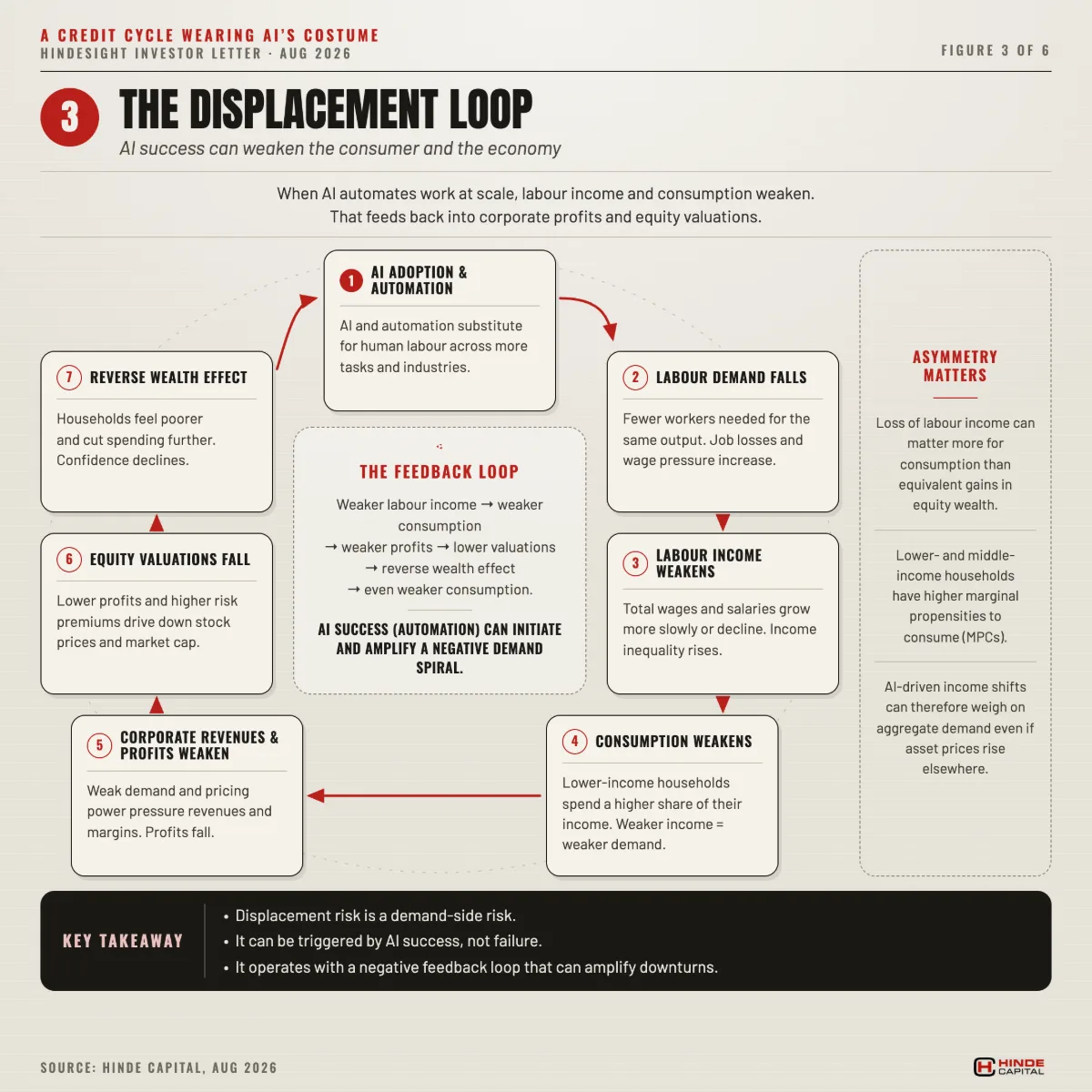
AI simultaneously creates another force through automation and labour displacement.
The corporate sector can individually become more profitable by replacing expensive labour with increasingly cheap intelligence while collectively weakening the income of the consumers expected to buy its products.
This produces one of the central economic paradoxes of AI. What is individually rational for every corporation may eventually become collectively destabilising for consumption.
There is also an important asymmetry in that mechanism. Although far more households now have exposure to equities through 401(k)s and retirement savings, financial wealth remains disproportionately concentrated among wealthier households, whose marginal propensity to consume additional wealth is relatively low. Employment income, by contrast, is distributed much more broadly among households with significantly higher propensities to spend their next dollar.
One dollar of equity wealth created at the top may therefore produce considerably less incremental consumption than one dollar of labour income destroyed further down the income distribution.
That potentially means the employment-displacement wheel does not need to become enormous before it begins offsetting the positive stock-market wealth effect.
Once stocks themselves begin falling, the two negative effects can operate simultaneously. Workers experience weaker income growth while asset holders lose wealth. Consumption weakens, corporate revenues soften, profits decline and equities fall further.
The positive Soros reflexivity which helped create the boom can begin operating in reverse without the underlying AI technology having failed at all.
The Price of Intelligence
There is then a third mechanism involving the price of intelligence itself.
AI should ultimately be structurally deflationary because intelligence is becoming cheaper, inference costs are falling, models are becoming more efficient and open-source models are increasingly capable. China also has powerful strategic reasons to encourage open AI ecosystems because commoditising intelligence can weaken the economics of expensive proprietary Western frontier models.
This produces another distinction which matters enormously for investors. The quantity of intelligence consumed can explode while the price of intelligence collapses.
A $30 trillion addressable market therefore does not mean AI companies capture $30 trillion of revenue. Indeed, one of the great paradoxes of AI may be that the more economically successful the technology becomes, the more aggressively it destroys the price of the very intelligence being sold.
If a task previously requiring $100 of human labour can eventually be performed for $1 of inference, AI may have captured the task economically while the AI provider captures only a tiny fraction of the value previously associated with it.
The distinction between value created and value captured is therefore fundamental.
There is a specific, testable version of this argument worth stating plainly at the application layer, the software built on top of frontier models rather than the models themselves. An application-layer company typically earns a gross margin equal to what customers pay minus the cost of the tokens it buys from frontier model providers to do the underlying reasoning. Early on, that margin can be healthy, because the wrapper is doing genuine work the raw model cannot yet do well on its own, whether a proprietary workflow, domain-specific prompting, or a user interface a professional actually wants to use. But frontier labs are locked in intense competition with each other and with open source, and a capability gap left unfilled by the model is, from their perspective, revenue someone else is capturing. They have every incentive to close it. As general reasoning capability improves, the specific value the application layer added starts to be reproduced by the base model itself, for free. The wrapper still has to pay for tokens and still faces low-barrier competition from other wrappers doing the same thing, so the price it can charge compresses from one side while its cost base holds firm or rises from the other.
This is not a supplier relationship in the ordinary sense, where an input provider has no particular interest in doing what its customer does. It is closer to a supplier whose own product improvements are directly substitutive for the customer's product.
The falsifiable version of this argument is observable in real time. Watch for compressing price-per-seat or price-per-task at application companies even as usage grows, and for churn spikes immediately following frontier model releases, as capability that used to require a specialist wrapper becomes available generically.
The exception, and it matters, is companies whose moat sits somewhere the model cannot absorb it, such as deep enterprise integration, regulatory certification, proprietary data the model never sees, or liability and trust structures. Those moats do not erode with model capability.
Perhaps the most important distinction in all of this, and the one most amenable to observation in the data as it arrives rather than resolved only in hindsight, concerns where today's earnings growth is actually coming from. At present, much of AI's measurable economic benefit appears to arise through cost reduction. Companies deploy AI to reduce headcount, automate workflows and accelerate product development. Those are genuine productivity gains, but they primarily improve margins rather than expanding the size of the economy.
The more interesting and more consequential question is whether AI eventually enables businesses to sell substantially more products and services by creating entirely new markets and sources of demand. Historically, technologies such as electricity, automobiles and the internet ultimately created industries that previously did not exist. Whether AI follows that path remains the key unanswered question, and it is a nearer-term, more falsifiable version of the same question that the rest of this piece asks about financing and timing.
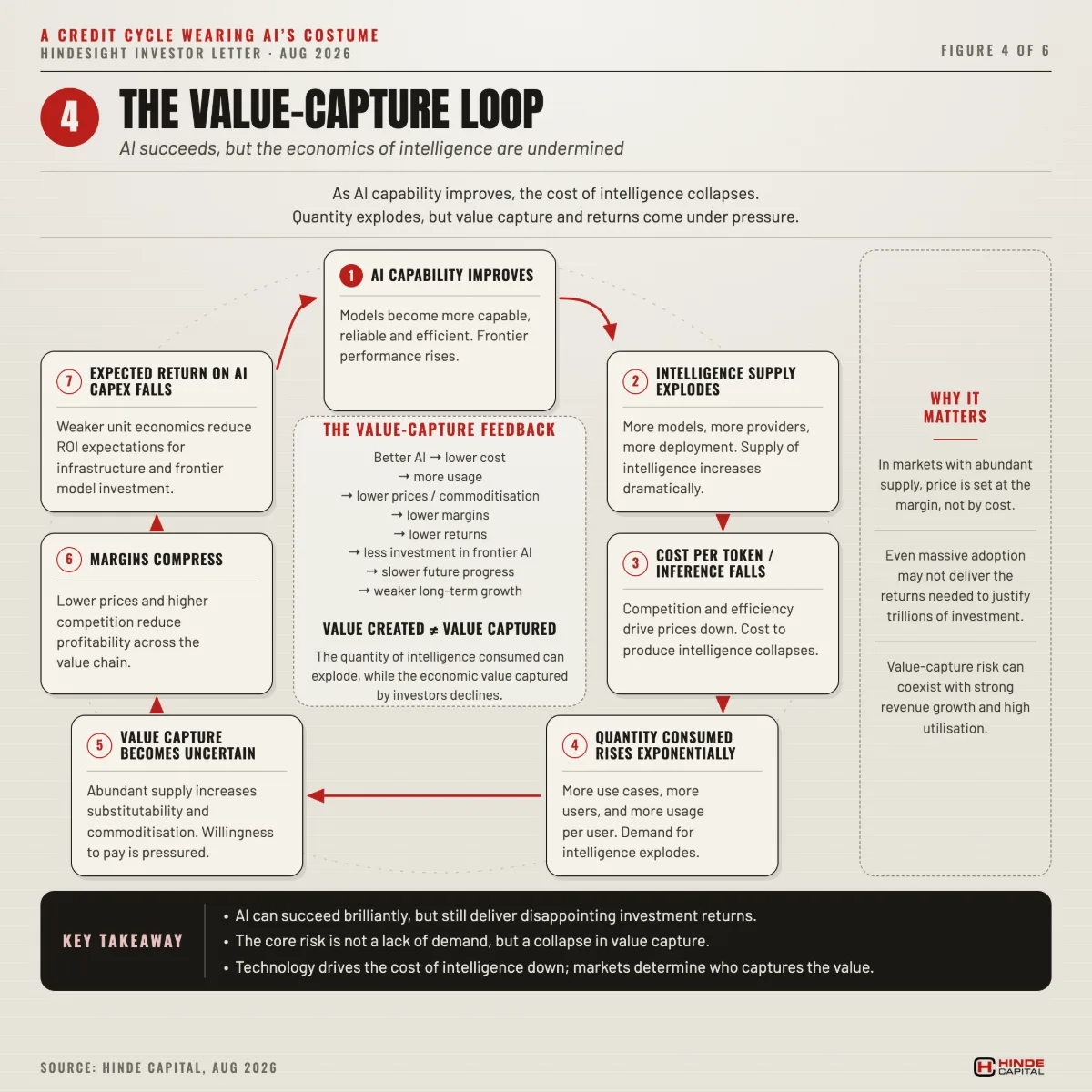
AI may perform work previously worth tens of trillions of dollars while charging a fraction of the historical cost. That could be wonderful for consumers and extraordinary for productivity, while simultaneously raising a much harder question about who captures the resulting economic surplus.
Is it the model provider? The semiconductor company? The cloud provider? The company deploying the technology? Or ultimately the consumer, who receives enormously more intelligence at almost zero marginal cost?
There is also a corporate-disclosure problem sitting underneath this question. Across 919 earnings calls from the sixty largest US-listed financial firms since 2023, nearly eighty per cent mentioned AI and more than half discussed its cost. Only two of those calls put an actual dollar figure on realised AI returns, and together they amounted to roughly $19 million.7 After several years of heavy AI spending, most large financial firms still cannot, or will not, quantify what any of it has returned.
That silence cuts both ways. It could simply reflect how early this is, since realised returns on a multi-year infrastructure build are genuinely hard to isolate this soon. But it could equally mean that a great deal of corporate AI spending remains an act of faith rather than a measured investment, and that the earnings currently validating the AI narrative are concentrated almost entirely on the supply side, Nvidia and the infrastructure complex, rather than showing up yet on the demand side that is ultimately meant to justify all of it.
The input side of the ledger is not cooperating either. Even as competition pushes the price of AI output down, the cost of the infrastructure behind it is moving the other way. Nvidia server pricing is reportedly rising by more than 15 per cent on some systems, Samsung is raising prices for advanced memory, and shortages could extend into 2027. Cheaper intelligence should eventually drive much higher usage, but a customer paying less per query while the underlying hardware costs more to build squeezes the margin from both directions at once, for whoever ends up holding the infrastructure. Given how much of that infrastructure is now financed with debt, private credit and SPVs rather than cash, a widening gap between AI cost and AI return is exactly the kind of demand-side disappointment a leveraged system can least afford.
This is also why I think consolidation among frontier LLM companies is eventually likely. The capital expenditure necessary to remain at the technological frontier is extraordinary while the unit price of intelligence is simultaneously being competed down. Not every frontier-model company can justify today's implied valuation if the eventual economics resemble increasingly commoditised intelligence delivered at dramatically lower margins. The potential deflationary consequences become especially interesting because enormous quantities of debt are simultaneously being created to build the infrastructure.
If inflation falls faster than nominal interest rates, real interest rates rise, making existing debt burdens more onerous in real terms. AI could therefore eventually reduce inflation while simultaneously making the debt incurred to build AI more difficult to service. Nominal revenues can disappoint, real financing costs can rise, collateral values can weaken and refinancing can become more difficult even while the underlying technology continues improving.
The Bond Market Sits Underneath Everything
And this brings us to what may ultimately determine whether all these reflexive loops remain stable. The Treasury market.
The Treasury curve is the discounting mechanism sitting underneath almost the entire structure. It prices mortgages and corporate credit, anchors infrastructure financing, determines the hurdle rate for AI projects, discounts the future earnings embedded in equity valuations and increasingly determines the financing cost of the US government itself.
The AI sector is no longer simply competing for GPUs, engineers, electricity, copper, transformers and turbines. It is increasingly competing for capital itself, and it is doing so at precisely the moment the US government has an enormous structural funding requirement.
Treasury currently expects $739 billion of privately held net marketable borrowing in the July to September quarter and another $628 billion in the October to December quarter of 2026. (U.S. Department of the Treasury)
That quarterly borrowing sits on top of a much larger rollover problem. Roughly a third of all outstanding US marketable Treasury debt, close to $10 trillion, matures within the next twelve months and has to be refinanced regardless of what the fiscal deficit does from here.8 None of that $10 trillion is new borrowing in the sense of funding fresh spending, but every dollar of it still has to clear the market at whatever yield prevails when it comes due, competing for the same investor demand as new deficit issuance and as the AI financing cycle described below.
At the same time, the AI ecosystem is embarking upon perhaps the largest private infrastructure financing cycle in modern economic history. Hyperscalers are borrowing, data-centre developers are borrowing, utilities need capital for generation and transmission, private credit is funding AI clouds and Nvidia's financing architecture aims to mobilise hundreds of billions more.
Treasury and AI are therefore increasingly arriving at the same capital-market door.
This is not a simplistic one-for-one crowding-out argument. Treasuries possess liquidity, regulatory and collateral characteristics which private credit cannot replicate. But institutional investors still allocate finite balance sheets and finite risk budgets. They can own a 10-year Treasury, hyperscaler debt at Treasury plus a spread, data-centre debt backed by a hyperscaler lease at a larger spread, or move further along the spectrum into private AI infrastructure credit offering a still larger return.
The Treasury market therefore has to clear at a yield attractive enough to absorb enormous sovereign issuance while the private economy simultaneously creates enormous quantities of alternative debt.
Housing is perhaps the clearest transmission mechanism. A higher 10-year Treasury yield generally translates into higher mortgage rates, which reduce affordability, weaken housing transactions and construction, lock homeowners into existing low-rate mortgages and reduce spending associated with moving, renovations, furniture and appliances.
Housing is also an enormous component of household wealth, so higher long-term Treasury yields can tighten the household economy substantially even without another Fed rate increase.
Exactly the same mechanism applies to AI infrastructure.
Suppose a project is financed at Treasury plus 250 basis points. With the Treasury at 3%, the debt costs 5.5%. With the Treasury at 5%, exactly the same project and exactly the same credit spread now cost 7.5%. Nothing about the GPU has changed. Nothing about the data centre has changed. Nothing about ultimate AI demand has necessarily changed.
But the economics have.
For Microsoft or Google this probably does not prevent the project from being financed. For the marginal neocloud, developer, SPV or leveraged infrastructure project, however, it can make all the difference.
Higher Treasury yields therefore produce a double hit. They increase the financing cost of building the AI infrastructure while simultaneously increasing the discount rate applied to the future profits investors expect that infrastructure to generate.
Both the project economics and the equity valuation deteriorate at the same time.
Credit markets are already pricing some of this. Oracle's five-year credit default swap spread has widened by roughly 70 basis points in 2026 to around 215 basis points, a multi-year high and the largest increase of any major technology name, prompting S&P Global to cut Oracle's rating to BBB-, the lowest rung of investment grade.
Broadcom's five-year CDS has widened by around 48 basis points over the same period, and Nvidia's has widened by roughly 32 basis points to around 82 basis points, its highest level since the contract began trading.10 Meta, Amazon and Alphabet have all seen smaller but still notable increases.
None of these levels imply distress in themselves, a CDS spread in the hundreds or thousands of basis points would signal that, but the direction is the point. Equity markets have continued to reward the AI capital-expenditure story, while the market for insuring the debt behind it is charging progressively more to do so, precisely the divergence between price and financing cost that a Minsky framework would expect to see first.
The bond market has not been left to find its own level. In early August, the US and Japan conducted their first joint currency intervention since 1998, with the Treasury buying yen alongside the Bank of Japan and the Ministry of Finance to pull the currency back from a forty-year low near ¥164 to the dollar. The stated rationale mattered more than the currency move itself. The real US concern was not the yen's level but what Japan might otherwise have had to do to defend it, namely sell US Treasuries. A unilateral Japanese intervention funded that way would have pushed US long yields higher at the worst possible moment, so Washington effectively co-financed the operation to keep that selling from happening.11 Then, before Kevin Warsh had even delivered his Jackson Hole speech, Bessent moved again, this time directly in the Treasury market. On 19 August he doubled the size of the Treasury's long-end bond buybacks, from $2 billion to at least $4 billion, and floated drawing down the Treasury General Account, its working cash balance at the Federal Reserve, which stood close to $950 billion, to help fund further purchases.
The mechanism is straightforward. Spending the TGA down releases reserves into the banking system, easing short-term funding conditions and creating visible demand for long bonds at the moment it is announced. It is a real lever, but a narrow one. Running down a cash balance is a one-time injection, not a change in the underlying supply and demand for Treasury debt, and it does nothing to shrink the roughly ten trillion dollars of existing debt still needing to be refinanced within twelve months.
Yields fell on the announcement and had round-tripped back to where they started within two days, and Bessent himself admitted on television that part of the move was simply signalling. Whatever firepower the TGA provides, it cannot make the rollover wall smaller.12 This is why I thought Kevin Warsh's Jackson Hole speech and the subsequent bond-market reaction were potentially significant. Warsh's comments were materially hawkish, reinforcing the Fed's commitment to returning inflation towards 2% and shifting market expectations towards a greater probability of further tightening.
The most dramatic reaction was naturally in the 2-year Treasury, which is particularly sensitive to the expected path of Fed policy. But I found the behaviour of the long end more interesting. The 10-year and 30-year initially rallied, presumably as investors interpreted a tougher Fed as positive for long-term inflation credibility, before that rally failed and long yields ultimately closed higher.
One day's price action proves nothing. But it provides a glimpse of what the potential trigger might eventually look like.
Warsh's speech worked against Bessent from the other direction. His remarks were read as leaving the door open to a rate hike rather than closing it, and the dollar rose against the yen on the day, giving back a meaningful part of the ground the August intervention had recovered.13 A currency operation designed to stop Japan from becoming a forced seller of Treasuries is not obviously helped by the Fed chair raising the odds that US rates go higher still.
By the end of that same week, Bessent was in Asheville chairing a G20 finance meeting, simultaneously pressing allies to shrink trade imbalances, threatening secondary sanctions on any country still buying Iranian oil, and trying to reassure the room about US debt and bond-market volatility.14 The three roles sit awkwardly together. It is difficult to run an aggressive sanctions and trade campaign with one hand while asking the same finance ministers for calm, patient demand for US Treasuries with the other.
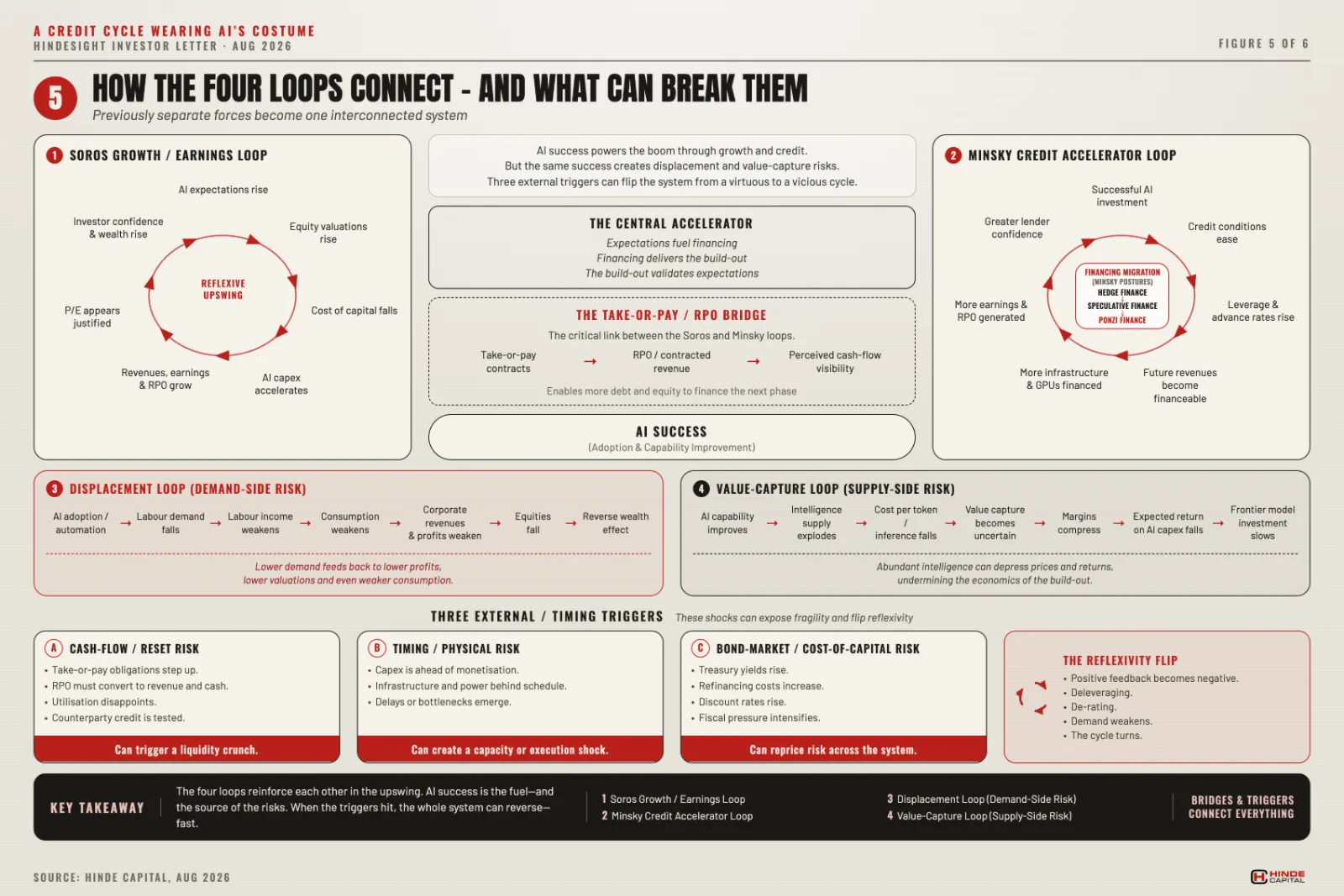
If the 10-year and particularly the 30-year Treasury yield begin moving persistently higher while equity valuations remain extreme and AI financing requirements continue accelerating, the bond market starts tightening three parts of the system at once. It raises the cost of mortgages and consumer credit, it raises the hurdle rate and financing cost of the AI capital-expenditure boom, and it worsens the government's own fiscal arithmetic through higher refinancing costs. These are not three separate pressures. They are the same yield working on three balance sheets simultaneously, and this is where the different reflexive mechanisms suddenly connect.
Higher inflation keeps the Fed hawkish and pushes the 2-year yield higher. Long Treasury yields remain elevated, lifting mortgage and consumer borrowing rates and weakening housing and consumption. At the same time, AI infrastructure becomes more expensive to finance, marginal projects become less attractive and AI capex expectations weaken.
Nvidia growth expectations then soften and equity valuations decline. The wealth effect reverses, consumption weakens further and capital-gains tax receipts fall, causing the fiscal deficit to deteriorate. Treasury then has to issue more debt into the same capital markets already being asked to finance the AI infrastructure boom, potentially putting further upward pressure on long yields.
At that point the loop has closed.
The equity valuation problem, the Minsky credit structure and the fiscal problem are no longer independent stories. They have become different parts of the same reflexive system.
There is an even more uncomfortable possibility. Normally when economic growth weakens, the Federal Reserve cuts rates and long Treasury yields fall with it, providing relief to housing, equities and corporate borrowers.
But what happens if the Fed cuts while the long end refuses to rally because the bond market is increasingly concerned about fiscal supply, term premium or inflation credibility?
The Fed could be easing because growth is weakening while mortgage rates remain high, AI infrastructure financing remains expensive, equity discount rates remain elevated and federal interest expense continues rising. The normal monetary-policy escape route becomes considerably less powerful.
That is why I think the bond market could ultimately become the trigger for the entire reflexive structure. Not because a particular level such as a 5% Treasury yield automatically causes a crisis, but because the risk-free rate sits underneath almost every asset and liability in the system.
It influences mortgage rates and consumer credit, sets the benchmark for corporate and infrastructure financing, discounts future AI earnings and increasingly determines the government's own financing cost.
A persistent move higher in long Treasury yields can therefore propagate simultaneously through housing, consumption, corporate credit, AI capital expenditure, equity valuations and fiscal policy.
When Tomorrow Has Already Been Financed Today
And this brings me back to the central point of the entire argument.
The biggest risk to the AI investment boom is not necessarily that the technology disappoints. It may be that the technology succeeds while the financial system extrapolates that success too aggressively into the present.
Musk could be right about extraordinary ultimate compute demand. Amodei could be right about an economic opportunity measured in tens of trillions of dollars. AI could become the most important productivity technology since electricity.
But none of those things tells us what the correct price is today for an Nvidia share, a GPU purchased with debt, an unbuilt data centre financed against a future lease, or a frontier-model company whose eventual product may be enormously valuable but increasingly cheap to consume.
Unlike 2000, we have the earnings. But that does not necessarily settle the valuation debate. It creates another one.
How much of those earnings represents sustainable final demand, and how much is being amplified by the extraordinary capital-expenditure and financing cycle surrounding AI?
If Soros is useful here, it is because he reminds us that fundamentals and prices are not always independent. Rising valuations can create the investment which creates the revenues which create the earnings which validate the valuations.
If Minsky is useful, it is because he reminds us what tends to happen next. Successful investment encourages credit creation. Successful credit encourages more ambitious underwriting. Current cash flows gradually give way to expected future cash flows, collateral values and assumptions about continued market access.
Technological demand is not necessarily revenue, and revenue is not necessarily profit. Physical useful life is not economic residual value. Enormous eventual compute demand does not guarantee high utilisation of a GPU today if there is no electricity available to run it. A $30 trillion addressable market does not mean AI providers capture $30 trillion of revenues. And enormous value creation does not tell us how that value will ultimately be divided between model providers, semiconductor companies, cloud providers, corporations and consumers.
The much harder investment question is who captures the economic surplus, at what margins, using whose capital, after how much technological depreciation, and how much of tomorrow's success have we already financed and capitalised today?
And sitting underneath all of it is the bond market.
Because if long-term Treasury yields continue rising, the system does not have the luxury of discovering the answer slowly. Higher yields simultaneously increase the financing cost of the infrastructure, raise the discount rate applied to its future earnings, weaken housing and consumption, tighten credit and worsen the fiscal arithmetic of the government issuing the risk-free asset against which everything else is priced.
Put simply, both sides of the P/E equation may now be reflexive. The numerator may be inflated by reflexive valuation, while the denominator may be inflated by reflexive capital expenditure. If that cycle turns, investors can face earnings contraction and multiple contraction simultaneously.
The technology can work brilliantly while the financial model built around it still breaks.
That is the question Minsky would ask. It is the question Soros would ask. And increasingly, I think it is the question the bond market may eventually force investors to answer.
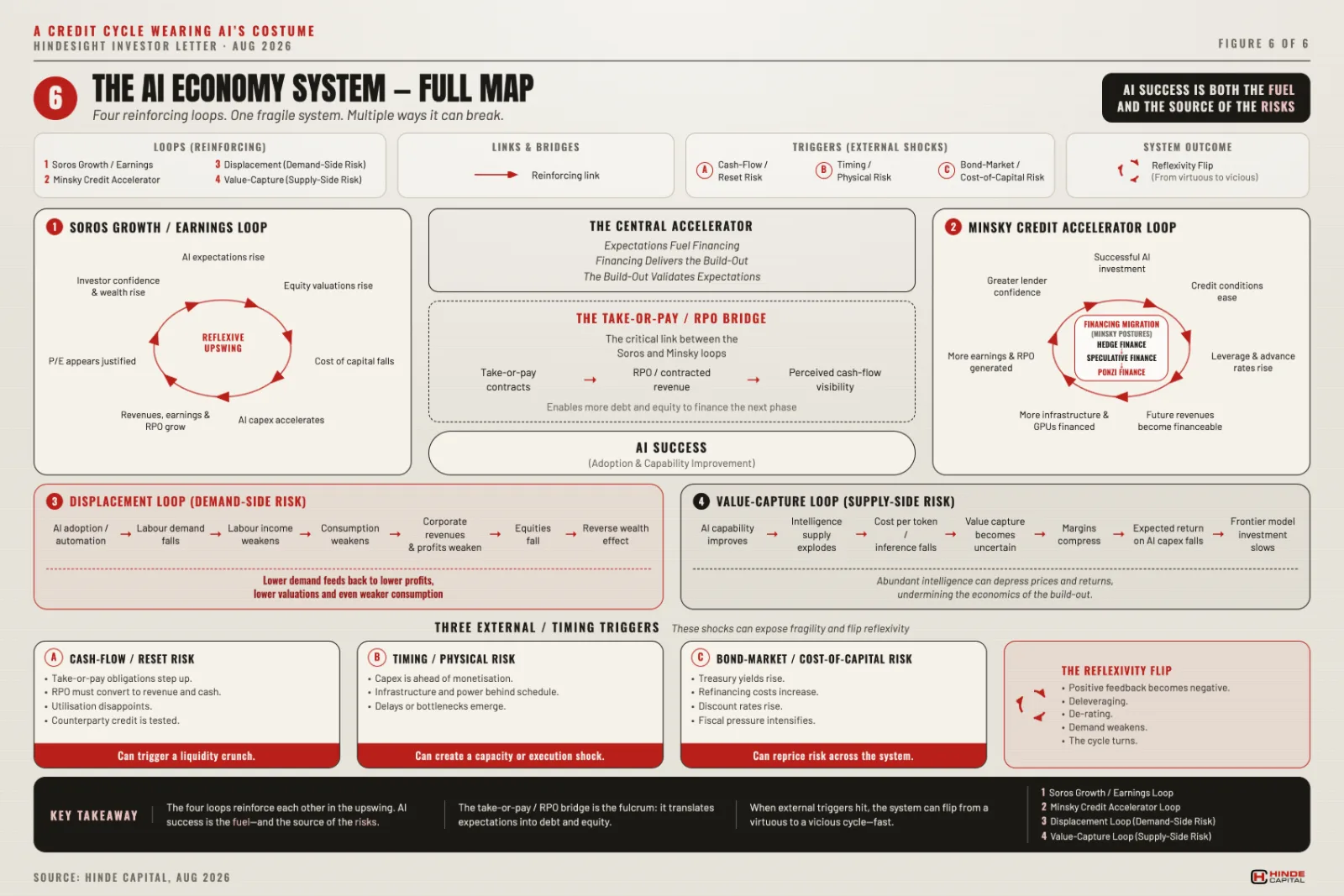
Sources
- 1 Nvidia, AI compute infrastructure financing announcement, 10 August 2026
- 2 Reuters, analysis of approximately $1.09 trillion of future hyperscaler lease commitments, 4 August 2026.
- 3 Nvidia Form 10-Q for the quarter ended 26 July 2026
- 4 US Treasury, marketable borrowing estimates, 3 August 2026
- 5 Reuters, market reaction to Kevin Warsh's Jackson Hole speech, 28 August 2026.
- 6 Reuters, global market reaction following Jackson Hole, 28 August 2026.
- 7 Bloomberg, “AI Talk on Wall Street Climbs. Dollar Figures Do Not,” analysis of 919 earnings calls from the 60 largest US-listed financial firms, data from Maximand Token Tape and SPEC Research, August 2026.
- 8 Joint Economic Committee (US Senate), Monthly Debt Update, Q1 FY2026 Treasury data, approximately 33% of US publicly held marketable debt maturing within 12 months; SIFMA, US Treasury Securities Statistics, $31.5 trillion marketable Treasury securities outstanding as of July 2026; GAO, Federal Debt Management (GAO-26-107529).
- 9 Reuters, hyperscaler bond issuance and credit spreads, August 2026; BofA Securities, hyperscaler bond issuance report, 9 January 2026; Moody's, credit assessment of AI hyperscaler debt and lease commitments, cited in Protos, 30 July 2026.
- 10 The Kobeissi Letter, five-year CDS spread moves for Oracle, Broadcom, Nvidia, Meta, Amazon and Alphabet, August 2026; Financial Times, LSEG data on Oracle, Nvidia, Alphabet and SpaceX CDS levels, cited in AI Weekly, August 2026; S&P Global Ratings, Oracle downgrade to BBB-, July 2026.
- 11 CNBC and Al Jazeera, US-Japan joint yen intervention, 1-3 August 2026; Japan Times, Japan and US confirm joint yen intervention, 3 August 2026; OMFIF, Japan's yen intervention and the US's unusual support, August 2026.
- 12 CNBC, Bessent moves to curb Treasury yields, putting new pressure on Warsh's Fed, 19 August 2026; Bloomberg, Bessent deploys debt buybacks in sign of concern over yield rise, 19 August 2026; CNBC, Bessent could tap near $1 trillion Treasury General Account to fund bond buybacks, 24 August 2026; Wolf Street, Long-term Treasury yields surge, wipe out effect of Bessent's buybacks in 2 days, 21 August 2026.
- 13 CNBC, Dollar rises to session high after Warsh comments, set for weekly gain, 28 August 2026.
- 14 CNBC, U.S. Treasury's Bessent faces G20 diplomacy test amid tariffs, Iran war, bond turmoil, 30 August 2026.
- 15 Groundbreaker Research, “The Teaser Period: Why the AI Boom Is Hitting a Reset Wall,” analysis of take-or-pay compute contracts, hyperscaler RPO disclosures, and modelled OpenAI and Anthropic revenue-coverage ratios, 20 August 2026.
- 16 Bank for International Settlements, Annual Report 2026, warning on debt-funded AI capital expenditure, widening credit spreads and circular-investment contagion risk, June 2026.
- 17 Stijn Van Nieuwerburgh, Columbia Business School, comments on OpenAI's reliance on Oracle's credit rating, cited in Unbox Future, “The 2026 AI Bubble Burst,” May 2026.
- 18 Man Group, “The AI Bubble: Hidden Risks and Opportunities,” comparison to telecoms fibre overbuild and private-credit NAV masking via lease make-whole clauses, August 2026.
- 19 FactSet Insight, “Hyperscalers Tap External Financing as AI Capex Outruns Cash Flow,” incremental debt share of capex and aggregate hyperscaler debt, 23 July 2026.
- 20 Oracle Investor Relations, Fiscal Year 2026 First and Third Quarter Financial Results (RPO of $455 billion and $553 billion respectively), September 2025 and March 2026; Oracle Fiscal Year 2026 Fourth Quarter results, RPO of $638 billion, up 363% year-over-year, June 2026; Yahoo Finance, Hyperscalers Hit $700 Billion in 2026 AI Spending Plans, May 2026.
- 21 NVIDIA, Vera Rubin platform announcements, CES January 2026 and GTC March 2026; NVIDIA Newsroom and Developer Blog, Rubin platform technical specifications, 2026.
- 22 Amazon.com, Form 10-K and 10-Q disclosures on server and networking equipment useful life changes, 2024-2026; Business Insider and Moneywise, reporting on Trainium 2 accelerator replacement at Amazon's Indiana data-centre campus, August 2026.
- 23 Hashrate Index, Used GPU Market: A100 and H100 Pricing and Depreciation, 2026; Compute Exchange and PC Server and Parts, secondary market GPU pricing guides, 2026.
- 24 CoreWeave, Inc., Form 8-K filed 15 September 2025, order form under Master Services Agreement with NVIDIA; NVIDIA and CoreWeave joint press release, 26 January 2026, $2 billion equity investment.
- 25 NAIC Capital Markets Bureau, private equity-owned insurer data cited in The Insurer, “Affiliated Investments by Private Equity-Backed Insurers Rise to $373 Billion,” 15 December 2025; ALIRT Insurance Research, “Privately-Owned Insurers in the U.S. Life Insurance Industry,” 9 July 2026, and “U.S. Life Insurance Industry In Transition,” 12 May 2026, on reinsurance cession growth 2020-2025; The American Prospect, “AI Bailout Could Be Baked Into Bubble: Private Equity, Life Insurers, Loans,” 3 August 2026; CEPR, “You Bet Your Life (Insurance): Private Equity Comes For Your Annuity,” 3 March 2026.
- 26 Bloomberg, “The Offshoring of America's Retirement Savings,” 16 November 2025, Bermuda-ceded reinsurance reserves; Insurance Business Magazine, ALIRT data on offshore reinsurance share, July 2026.
- 27 U.S. Securities and Exchange Commission filings on monoline bond insurer ratings, 2008; The Bond Buyer, “10 Years Later: How the Financial Crisis Reverberated into Municipal Bonds,” 2018.
- 28 State life insurance guaranty association coverage limits and assessment mechanisms, as described in Drall, Pranjal and Andrew Granato, “Private Credit's State Backstop: How Private Equity Socializes Risk Through Insurers,” SSRN, 9 August 2026.
- 29 Advisor Perspectives, “AI's Trillion-Dollar Debt Binge Fuels Century-Old Private Market,” citing Private Placement Monitor data, 1 July 2026; CNBC, “AI Data Centers Financing Insurance Deals GPU Debt,” comments by Tom Harper, data centre leader at Gallagher, 6 April 2026.
This is not investment advice. It is one person thinking out loud about markets, usually with a position on, so assume I may be talking my own book. That is not a confession, merely useful information. Views can change quickly, occasionally before the ink is dry, and I am not going to defend a trade simply because I once wrote about it with great conviction. Nothing here is an offer, solicitation or recommendation to buy or sell anything.
I write HindeSight primarily for me. The process forces me to test the thesis, join a few dots, throw some away and, with luck, understand the problem rather better than when I started. If it sparks a thought in someone else, even better. There is no publication schedule. I write when I have something to say or when the urge becomes sufficiently annoying that writing it down is easier. I can be tactically bearish and medium-term bullish, long one week and short the next. Markets rarely reward consistency for consistency’s sake. My objective is simpler: find the best risk/reward and try to extract as much upside as possible while giving as little back as possible.
Hinde Capital no longer manages external capital, so there is nothing to sell you. Past performance is no guide to future returns and, frankly, neither is this letter. Do your own work, size risk so you can still sleep, and seek regulated advice where appropriate. No liability is accepted for losses arising from reliance on this material, including those incurred after forwarding it to your sister- or brother-in-law. © Hinde Capital 2026.